Sourdough Focaccia is, I think, easier than a loaf of sourdough bread. It’s very forgiving: it’ll still taste fine if under-proofed, it’s hardly noticeable if a little over-proofed, and there’s no real shaping required. Plus, you can be creative with the toppings.
You still need to know your sourdough starter and its habits before attempting a focaccia. If your starter is weak, or used before/well after peak, you won’t get the lovely bubbles in the dough; Focaccia’s signature characteristic.
I love making Focaccia because it’s lower maintenance than a loaf of sourdough bread, but also because it’s so much fun. The last step, pre-bake, of covering the dough in oil and poking your fingers in to create the trademark dimples is legitimately one of my very favorite activities.
This recipe and build is based on my favorite Instagram baker, Gareth at Memoirs of a Baker‘s recipe and process. He’s a humble sourdough genius, and general baking wizard, too. He has loads of wisdom and countless inspirational bakes on his page, so definitely check him out!

What Should I Use to Top my Sourdough Focaccia?
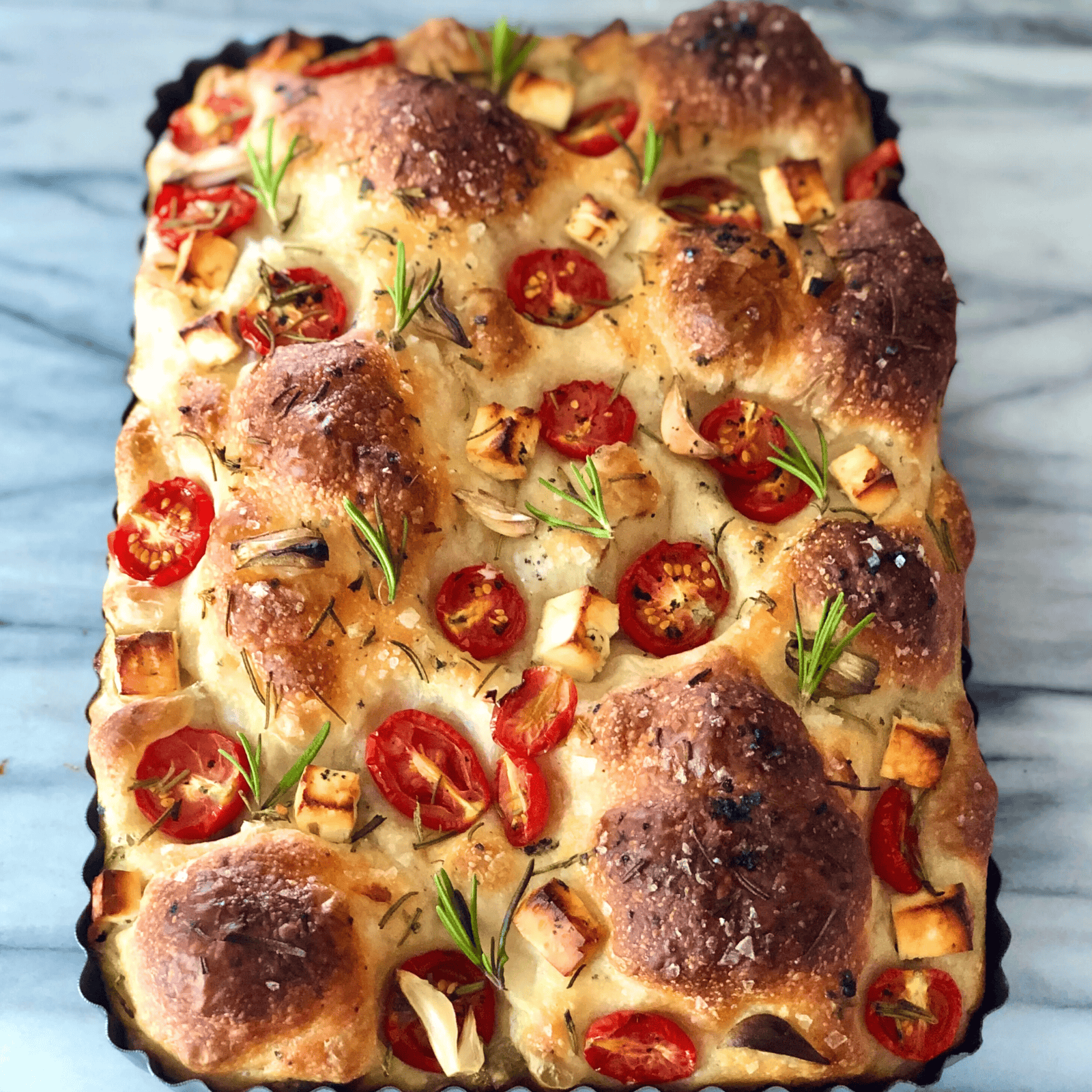
You can top your Sourdough Focaccia with just about anything! Here’s my go-to topping list:
- Halved grape or cherry tomatoes (about 12, cut in half)
- Whole fresh garlic cloves (because if you don’t love tons of garlic, you’re dead inside)
- Coarsely cubed feta or goat cheese
- Roughly chopped rosemary, saving some pretty sprigs for adding post-bake
- Coarse sea salt
- Icelandic black lava salt (something I picked up in Reykjavik and I’m obsessed!)
Here are a few other topping ideas:
- Leave it simple and just use EVOO and coarse salt
- An assortment of vegetables and fresh herbs
- Whatever you’re growing in your garden
- Get weird with it and throw chunks of dark chocolate, fresh thyme and crumbled blue cheese (I started typing that as a joke, but that actually might be good … I’d try it!)
Note about toppings: Some herbs, cheeses, and other toppings can burn in the oven. I usually reserve half to all of my herbs to add right as the focaccia comes out of the oven. Some cheeses like feta are fine, but if I’m using goat cheese, I tend to wait until there’s about 5 minutes left on the timer, pull out the focaccia, add the cheese, and finish baking. This allows the bread to absorb some of the flavor, and the toppings to adhere, without burning them in the hot oven for the full bake time.
Fun Focaccia Flavors
Once you’re comfortable with the basic Sourdough Focaccia, feel free to get creative with adding flavors like pureed vegetables, pesto, or anything else your heart desires! Start with less than you think, just to be sure you don’t kill the rise. Check out the beet focaccia I made below – I added roasted, cooled, pureed beets to the dough after the salt was added, and also added the juice of one lemon, to preserve the color as it baked.

Proofing & Shaping Sourdough Focaccia
Just note that with focaccia, it’s okay to overproof a little. It doesn’t need to maintain its shape when baked, like a loaf of bread, so you can let it get a little carried away and bubble more than you would with a loaf.
Do I Really Need Bread Flour?
Yes. I don’t recommend using all-purpose flour here. Bread flour provides the structure this Focaccia needs to rise perfectly and gives it the best possible texture. If you’re going through all the effort to make something with sourdough, you might as well do it right!
The Pan
- I recommend using a 9 x 13-inch / 22×33 cm pan with sides that are at least 3″ / 7.5cm deep.
- Pans that aren’t as deep will work, but it’s possible the focaccia will overflow and make a mess in your oven.
- I like to line the pan with nonstick foil or parchment paper, for easiest removal from the pan.
- You can use a glass pan here, but I really recommend a light-colored metal pan, if possible, for the best crust texture.
- Please don’t use silicone (which can prevent the focaccia from developing a nice crust) or a dark-colored metal pan (which may cause excess browning before the middle is done).
How to Serve Focaccia
I often enjoy Sourdough Focaccia by itself, fresh from the oven – or simply add a nice salted butter. I also love to serve it for lunch with fresh burrata and balsamic oil, or beside pasta for dinner. It also makes an incredible sandwich!
Be sure to wait to slice it until it has cooled a bit – if you cut it up while piping hot, the crumb might feel kind of sticky and gluey, instead of soft and fluffy.
How to Store Sourdough Focaccia
Sourdough Focaccia will keep for up to 1 day inside an airtight container, but it loses a lot of its magic the next day. I use it for a grilled cheese, if I don’t eat it all Day One, but it’s definitely harder to chew and nowhere near as pleasant. My advice is definitely to eat it all the day it’s made, whenever possible.

More Recipes You’ll Enjoy:
- Sourdough Bread: A Crash Course – read this if you’re still learning about sourdough!
- Sourdough Discard Cornbread – the best use for sourdough discard
- Interview with the Vampire Cookies – my other favorite use for discard!
- Tsoureki Recipe aka Greek Easter Bread
- Homemade Hawaiian Rolls

Sourdough Focaccia
Ingredients
- 400 grams bread flour, I like King Arthur's bread flour
- 320 grams room temperature water, around 75°F / 24°C
- 120 grams active, bubbly sourdough starter
- 10 grams salt
- Desired toppings, see Notes below for my go-to toppings
Instructions
- In a large bowl, add the bread flour. Add 310 grams room temperature water. Mix to combine, then cover and rest for 1 hour.
- Add active starter and mix thoroughly to combine. Cover and rest another 30 minutes.
- Add the salt and the remaining 10 grams of water and mix together thoroughly. I typically use my hands for this step, as the dough tends to separate slightly with the additional water. Using your hands allows you to continue kneading and scrunching it back together until cohesive. This may take 5-10 minutes. Once combined into a smooth dough, shape into a ball and cover. Rest 1 hour.
Folds:
- Depending on the temperature of your kitchen, and the activity level and strength of your sourdough starter, the timing of your folds, and the length of bulk fermentation will be impacted. The next step assumes your kitchen conditions are an ideal 75°F / 24°C, and that your starter was perfectly active. If your kitchen is much warmer than this, the time in between each fold will be shorter (try 20-30 minutes). If you kitchen is much cooler than this, you can space the folds apart by an hour or so.
- Perform 3-4 coil folds, spaced 45 minutes apart, then shape your dough into a ball. Place in a clean bowl.
Bulk Fermentation:
- Cover the bowl tightly with plastic wrap and place in the coldest part of your fridge overnight.
Shape:
- The next morning, preheat your oven to 500°F / 260°C.
- Line a 9 x 13-inch / 22×33 cm pan (at least 3" / 7.5cm deep) with nonstick foil or parchment paper. Oil the lined pan with some little with extra virgin olive oil (you can use regular olive oil, but I prefer the EVOO for this).
- Gently transfer the dough to dough in the lined, oiled pan. Pour on a very liberal helping of EVOO, spreading it to cover the top of the dough with your hands. Gently encourage the dough into the pan's rectangular shape. If your dough isn't at all bubbly at this point, or is too cold to shape, allow to rest for 15-30 minutes at room temperature.
Dimple and Top:
- Dimple all over with your fingertips, all the while encouraging the dough into the corners a bit more, and attempting to avoid popping the lovely bubbles that should naturally occur as you dimple. Be sure to dimple erratically; you don't want this to be super neat and tidy – it's more fun when it's dimpled haphazardly!
- Add your desired toppings evenly across the top. Press larger items into the dough a little, to make sure they adhere.
- Note: If you're adding chopped fresh herbs, reserve at least half until after baking, to avoid them all burning in the oven.
Bake:
- Reduce oven temperature to 425°F / 220°C and bake for 20 to 25 minutes, or until focaccia is deep golden brown.
- Right out of the oven, add fresh herbs evenly across the top, if desired. Allow to cool slightly (at least 15 minutes) before slicing and serving.
- Sourdough Focaccia will keep for up to 1 day inside an airtight container, but it's definitely best enjoyed the same day it's made.
Notes
- Halved grape or cherry tomatoes (about 12, cut in half)
- Whole fresh garlic cloves
- Coarsely cubed feta or goat cheese
- Roughly chopped rosemary, saving some pretty sprigs for adding post-bake
- Coarse sea salt
- Icelandic black lava salt