Marrying into a Greek family, I was immediately tasked with my first bake for the family Easter celebration: Tsoureki.
I’d never even heard of Tsoureki before, let alone tried it, so I took to the internet to research what this bread was supposed to look, taste, smell, and feel like.
I quickly became infatuated with the descriptions I found. This traditional Greek Easter Bread was supposed to be sweet, rich, and sturdy. The descriptions sounded similar to a brioche bread, but with vastly different flavors.
Combining a few old family recipes, I created this recipe below – and my in-laws were so kind about this Australian girl’s attempts at recreating their special bread. It wasn’t until I finally visited Greece many years later that I realized just how spot-on my recipe really was!
This Tsoureki Recipe is now something I look forward to making every year, and my entire extended family anticipate it eagerly. There’s never a crumb left over!

The Spices and Flavors in Tsoureki
This recipe uses mastic gum (also known as mastica or mastiha), derived from pine trees, and ground mahlepi (sometimes spelled “mahleb”), a spice made from ground wild cherry pits. Both are common in Greek cuisine, and both bring their own distinct, unique, and utterly magnificent flavors to this sweet bread.
These spices can be hard to source in stores outside of Greece, but are found easily online. You can also try your local Greek Orthodox church, as ours has a small store that carries mastic gum, so I only need to find the mahlepi online.
I also love to add the zest of an orange, for a hint of bright, fresh citrus flavor, and a little anise powder (ground star anise) because it provides a fantastic depth of flavor. I buy the anise powder from my local Penzey’s, but you can also find it online.
Other Important Ingredients for Greek Easter Bread
- Be sure to use bread flour, not all-purpose or any other types of flour. This may be known as strong flour where you live. You need to give this bread some backbone against all the rich ingredients like butter, milk, and eggs, so don’t skip this ingredient.
- Use large eggs, not medium or extra-large. This will impact the texture of the bread. The eggs should be around 55 grams in shell.
- I recommend using unsalted butter to avoid salt outshining the sweet flavors and spices in your bread.
- Use whole milk, or full-fat milk. That extra fat helps your bread stay soft!
- Use regular granulated sugar, not brown sugar or any other variety. This is also known as white sugar, depending on your location.
- I recommend using instant yeast, but if all you have is active dry yeast, do this first: in a small bowl, mix the yeast with the lukewarm water in the recipe + a pinch of sugar and cover until frothy and foamy, about 10 minutes. Then proceed with the recipe as written.
Kneading Tsoureki
I’m not going to lie; this bread can be a challenge to knead. The recipe is quite large and will give your mixer a real challenge. Please, please keep an eye on your mixer, and feel free to give it a rest from kneading for 10-15 minutes if it starts to feel hot to the touch, or make any strange noises. I once burnt out my KitchenAid’s motor because I ignored its pleas for help, so don’t be as silly as I am!
If you are concerned for the wellbeing of your stand mixer, stop the mixer and either give it a rest, or take the dough out and finish kneading by hand. It’ll be a workout, so sometimes I split the dough in two so it’s not such a huge amount of dough to work at once. Knead by hand until it just about passes the windowpane test. It doesn’t have to be as silky-stretchy as a typical brioche, but you do want it to have developed a good amount of gluten.
Proofing Greek Easter Bread
Like most breads, this Greek Easter Bread needs to rise once after kneading, and again after shaping. The time this takes depends entirely on your kitchen environment. I have provided time estimates below, but note that if your kitchen is very hot, it may take less time to rise, and if your kitchen is very cold, it will take longer.

Does Tsoureki Include Dyed, Hard-Boiled Eggs?
Traditionally, when shaping, hard-boiled eggs dyed a vibrant red were incorporated to the braids of the Tsoureki – but even in Greece, this isn’t as standard as it perhaps once was. For ease and simplicity, nobody will mind if you skip this step.
Shaping Braided Breads
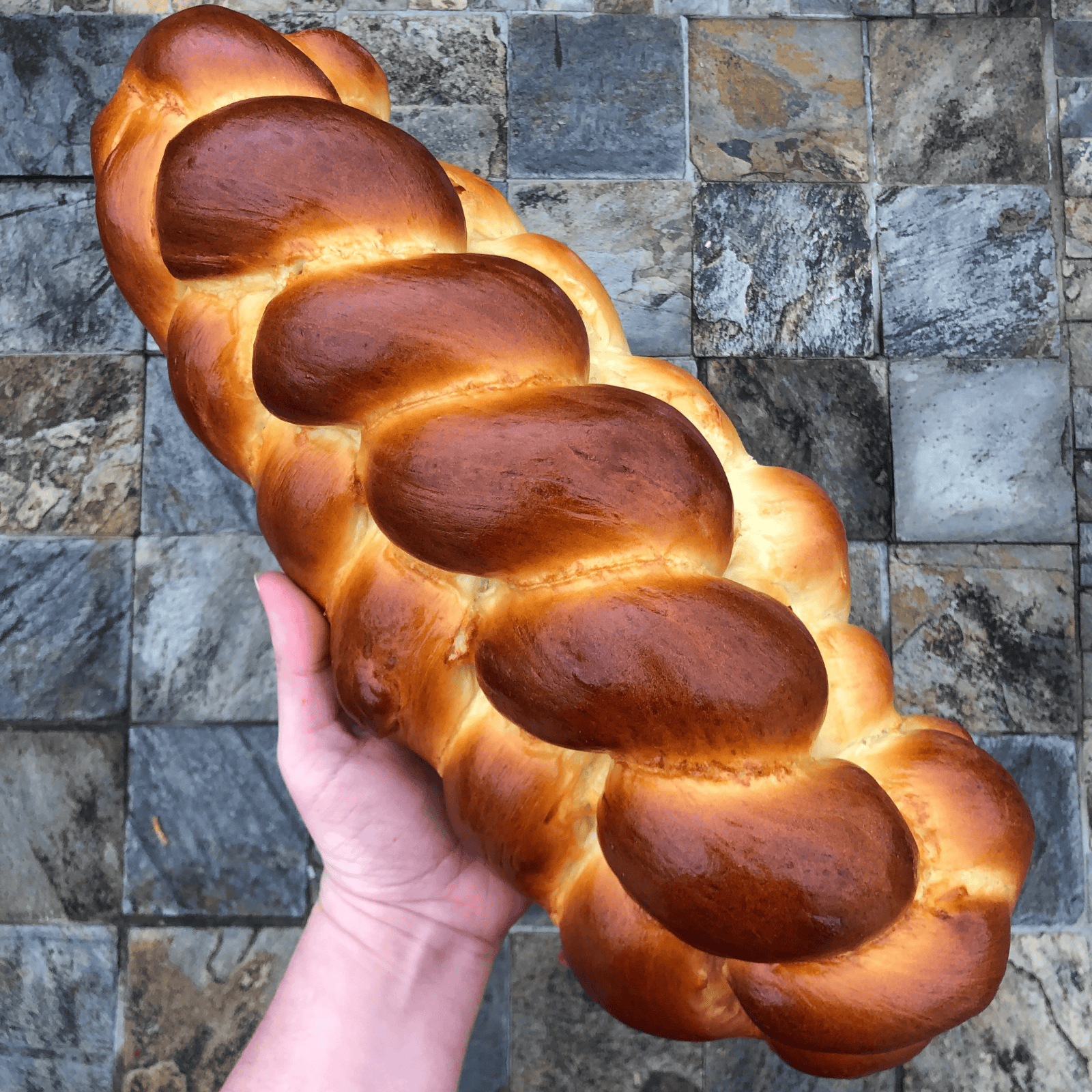
- Traditionally, Tsoureki is shaped by dividing the dough into three equal portions, and braiding it just like you’d braid hair.
- I’ve also done a five-strand braid, when I wanted to experiment and feel fancy, as you can see in the first photo above.
- Feel free to experiment with any shaping technique you like, but the simple three-strand braid is quick and easy.
- To shape each portion into logs, roll with firm, even pressure on an unfloured surface, and intermittently pick up each piece and firmly shake to stretch the strands out. This technique helps give the Tsoureki its unique texture.

Finishing the Bread
Before the Greek Easter Bread hits the oven, give it a quick egg glaze. You can then sprinkle the tops of the breads with flaked almonds, sesame seeds, or leave the tops plain. I personally prefer to leave the tops plain because I adore the texture of this special bread so much that I don’t want any toppings to interfere with that texture.
What to do with Leftover Greek Easter Bread?
This bread keeps beautifully when stored inside layers of plastic wrap at room temperature. It’ll stay soft and delicious for about 5 days – though it never lasts that long around my house! It’s a great side dish for a roast, but I particularly love it for breakfast. Serve it with butter and jam, or make it into the most unbelievably flavorful French toast you’ll ever try.

More Recipes for Easter Celebrations:
- Homemade Banoffee Pie
- French Silk Pie Recipe
- Vanilla Cake with Strawberry Buttercream
- Lemon Tarts
- Sourdough Discard Cornbread

Tsoureki (Greek Easter Bread)
Ingredients
For the Bread:
- 135 grams unsalted butter, cubed
- 135 grams whole milk
- 200 grams granulated sugar
- 4 large eggs, at cool room temperature
- 870 grams bread flour
- 21 grams instant yeast
- 100 grams water, 100-110°F (38°-43°C)
- zest of one orange
- 5 grams mahlepi, aka mahleb
- 5 grams mastiha, aka mastic gum
- 1 gram ground anise, aka anise powder
For the Egg Wash:
- 1 large egg
Instructions
- Use a pestle (or a spice grinder) to grind the mastiha and mahlepi. Set aside.
- Place the butter, sugar, and milk in a small saucepan over low heat. Stir occasionally until the butter has melted and the sugar has dissolved. Cool until it’s around 100°F / 38° (no hotter than 110°F / 43°C, or you risk killing the yeast).
- In the bowl of a stand mixer, place the lukewarm water, yeast, eggs, orange zest, and yeast mixture. Whisk to combine. Add the flour and spices.
- Using the dough hook, mix on low speed until the ingredients start to combine. Increase speed to medium, then increase to medium-high for about 15–20 minutes (watch carefully as this is a large amount of dough and can overwhelm a standard stand mixer. Feel free to give the mixer a break for 15 minutes or so if it feels hot to the touch or makes odd noises). Once kneaded properly, the dough should be really soft, just a little sticky, and elastic enough to just about pass the windowpane test.
- Cover the bowl with plastic wrap and place in a warm environment, until doubled in size. This will take about 1-3 hours, depending on your kitchen environment – the hotter it is, the shorter it will take, and the colder it is, the longer it will take.
- Gently deflate the dough. Using kitchen scales, cut the dough into six* equal portions (three for each loaf). Roll each piece into a rope, rolling firmly on an unfloured work surface and intermittently picking up and shaking the ropes (this helps form the authentic texture).
- Braid three strands together, pinching the ends together to seal. Tuck the ends under, and place on a large parchment-lined baking tray. Repeat for the second loaf, spacing several inches apart to allow for expansion as they proof and bake.
- Cover the baking tray with a clean kitchen towel and allow to double in size – about 1 hour (again, this will be longer or shorter, depending on your kitchen environment). Meanwhile, preheat the oven to 340°F / 170°C.
- In a small bowl, whisk together the remaining egg and 1 Tablespoon of water. Brush loaves with egg wash, being careful not to deflate but ensuring you glaze all the nooks and crannies.
- Bake for 40-50 minutes, until golden brown. If you’re not sure, feel free to take the internal temperature of the bread with an instant thermometer. The bread is done when it’s around 190°F / 88°C.
- Allow loaves to cool completely on the baking tray. Wrap each loaf well in plastic wrap. Store for up to 5 days at room temperature unsliced, for about 3 days sliced if kept inside an airtight container. You can also freeze loaves, well wrapped in layers of plastic wrap and a layer of foil (to prevent freezer burn) for up to 3 months.